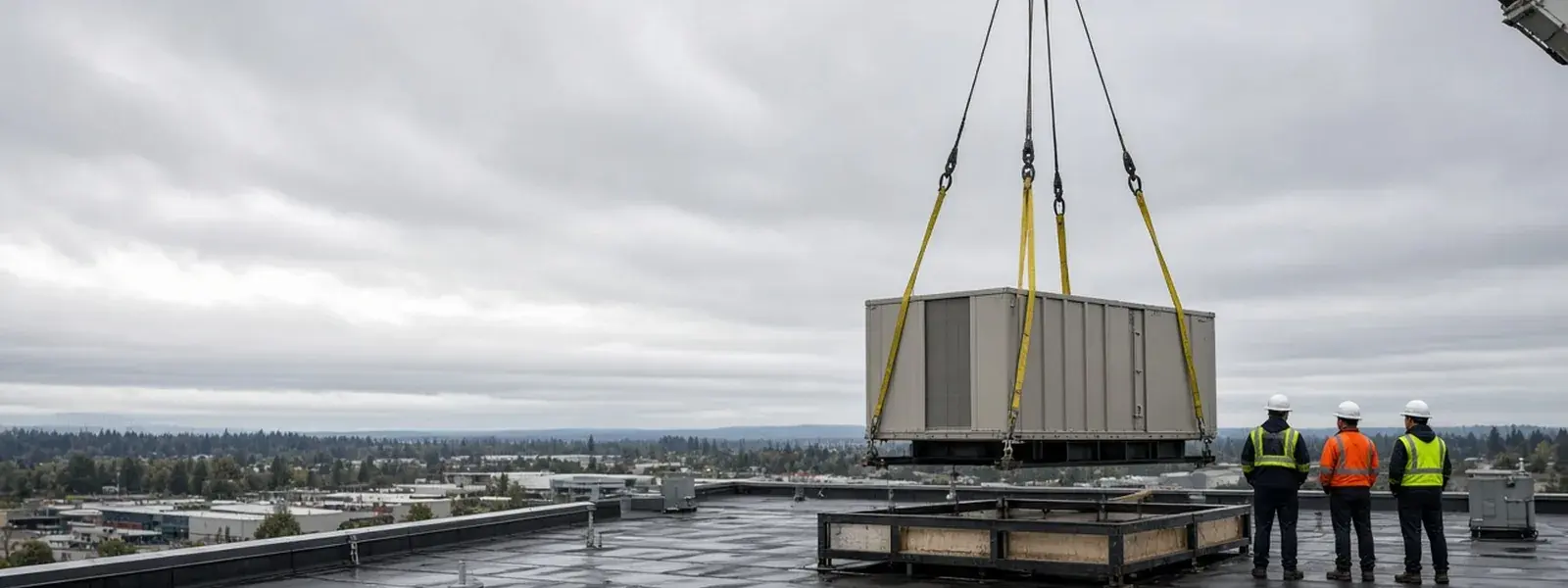
When a packaged rooftop is past a sensible repair, you need a crane-set changeout that matches the curb, the gas, and the electrical, not a catalogue guess. Langley Quality Commercial HVAC replaces 5 to 25 ton RTUs that have sat on Langley curbs since the 1990s and 2000s, and we size the new cabinet from load and duct, not from the old nameplate alone. A like-for-like drop on a short curb can still leave you with the same hot suite if the old 10-ton was already undersized. We measure the curb, the disconnect, and the duct before the crane is booked.
Most Langley replacements are still gas-electric packaged units. The new box will be SEER2 rated, with a different footprint than the 1998 unit it replaces, so a curb adapter is the rule, not the surprise. We plan that adapter, the gas regulator, and the electrical MCA before lift day.
Neighbour suites keep running when each shop has its own curb. The crane window is the disruption. We stage it so the plaza lot and the roof opening are ready, then the old cabinet comes off and the new one lands on a prepared adapter.
What is on the ticket
- Manual N or equivalent commercial load look at envelope, occupancy, and exhaust
- Data plate review of the existing unit: tons, refrigerant, MCA, MOP, gas
- Curb measurement, level check, and adapter or new curb spec
- Electrical match: voltage, phase, disconnect, and breaker or fuse
- Gas pipe size, regulator, and Technical Safety BC permit path
- Duct transition, hanger, and canvas connector at the new supply and return
- Crane or boom plan, lift window, and roof protection
- SEER2 packaged unit selection with economizer and heat type
- Startup: charge, superheat, subcooling, manifold pressure, and ESP
- Data plate photos and as-built notes for the property file
When this call shows up
The compressor failed and the cabinet is already rusted through
A second circuit on a 20-year R-22 box is a poor spend. Replacement is the cleaner conversation when the floor, curb, and heat exchanger are tired too.
The heat exchanger is cracked
That ends the repair path on a gas rooftop. The cabinet comes off. We don't patch a cracked exchanger and call it a plan.
A tenant improvement needs more tons or more outdoor air
A kitchen, a denser office, or a new glass storefront changes the load. Matching the old 7.5-ton nameplate will leave the suite short.
The curb leaks and the unit has walked out of level
A changeout is the moment to reset the curb, replace the gasket, and land a cabinet that actually sits flat. Repair won't fix a shifted curb.
Parts for the old refrigerant or board family are gone
Orphaned R-22 circuits and obsolete controllers turn every service call into a scavenger hunt. A SEER2 replacement ends that chapter.
How we work the roof
Read the old data plate and the room, not just the tons
We take model, serial, refrigerant, gas, and electrical from the existing cabinet, then walk the suite for occupancy, glass, kitchen exhaust, and duct that was never in the original load.
Run a Manual N style load and pick SEER2 equipment
Envelope, people, lights, and exhaust decide tons and outdoor air. Then we select a packaged unit that fits the curb family, voltage, and heat type you actually have.
Measure the curb and design the adapter
1990s and 2000s curbs rarely match a current footprint. We measure opening, height, and square, then spec an adapter or a new curb so the new cabinet doesn't sit on a hope and a bundle of screws.
Stage gas, electrical, and the crane path
Disconnect size, MCA, gas cock, and regulator get confirmed. The crane needs a clear pad or street window. Neighbouring units stay live if they sit on their own curbs.
Set, connect, and commission
After the lift we set charge, superheat, subcooling, gas manifold pressure, inducer draft, economizer minimum, and external static pressure. You get startup numbers, not just a running fan.
Why this shop for rooftop unit replacement
We don't copy a bad nameplate
If the old 10-ton never held the suite, a new 10-ton won't either. Load and duct come first.
Curb adapters are designed, not improvised on lift day
A SEER2 cabinet on a 1998 curb needs a real adapter. We measure it in advance so the crane isn't waiting on a sawzall.
Gas and electrical are part of the same job
Technical Safety BC gas work and the disconnect upgrade travel with the cabinet. You are not coordinating three trades from the parking lot.
Neighbour suites can stay open
Plaza changeouts are unit-by-unit. We isolate one curb. The rest of the strip keeps its own rooftops.
Commissioning numbers go in your file
Superheat, subcooling, ESP, and manifold pressure are written down. The next tech, and the next budget year, can see what landed.
The Langley detail
A huge share of Langley rooftops are 5 to 25 ton packaged units that landed between the mid-1990s and the late 2000s. Those cabinets were built around R-22 or early R-410A, older IEER numbers, and curb footprints the factories have since abandoned. A current SEER2 replacement from Carrier, Lennox, Trane, or York will almost never drop onto that curb without an adapter. The adapter isn't trim. It is the air seal, the weather seal, and the structural seat. We measure the existing square, the insulation stop, and the duct opening before anyone prices a crane. Showing up on lift day with a unit that's three inches off in both directions is how you create a permanent leak into the suite.
Copying the old tons is the most common way a replacement still fails. Manual N, or an equivalent commercial load, looks at glass, occupancy, kitchen exhaust, and the lighting load the tenant actually runs. A 1999 shop that became a restaurant, or a dark warehouse that became a lit studio, isn't the same building the original 8.5-ton served. We also read external static pressure on the existing duct. If the old blower was already off the fan table, a new high-SEER2 cabinet with a tighter coil will be worse unless the duct or the pulley package changes. Replacement is a system job, not a box swap.
Gas and electrical decide whether the new unit can even start. Many Township warehouses are 208/3. Plenty of smaller City retail is 240/1 or an odd leftover voltage. MCA and MOP on a SEER2 cabinet are not the same as the 1998 plate. The disconnect, fuses, and sometimes the feeder have to move with the unit. On the gas side, manifold pressure, pipe size, and the regulator have to match the new burner. That work sits under Technical Safety BC rules. We treat the permit and the pipe as part of the changeout, not a surprise invoice after the crane leaves.
Lift day is logistics as much as mechanical. Plaza lots need a pad the crane can sit on without blocking every tenant. Warehouse yards need overhead lines and truck courts checked. We protect the membrane, pull the old cabinet, set the adapter, and land the new unit in one planned window. Canvas connectors get replaced so the new cabinet isn't rigidly tied to a duct that will tear. After the lift, commissioning is the job. Charge to the data plate, superheat and subcooling on each circuit, economizer minimum outdoor air, and a gas heat run that proves the inducer, flame signal, and limits. A spinning blower isn't a finished replacement.
Langley Quality Commercial HVAC runs rooftop unit replacement as a measured changeout: load, curb, gas, electrical, crane, then startup numbers. If you are staring at a rusted 1990s or 2000s cabinet and a failed compressor, send the data plate photo and how a crane would sit on your lot. We will tell you what should land on that curb, whether an adapter will seal, and what has to change on the gas and electrical before the lift is worth booking.
Towns we cover
Work is dispatched from Langley across the Fraser Valley. See every municipality on the where we work page.