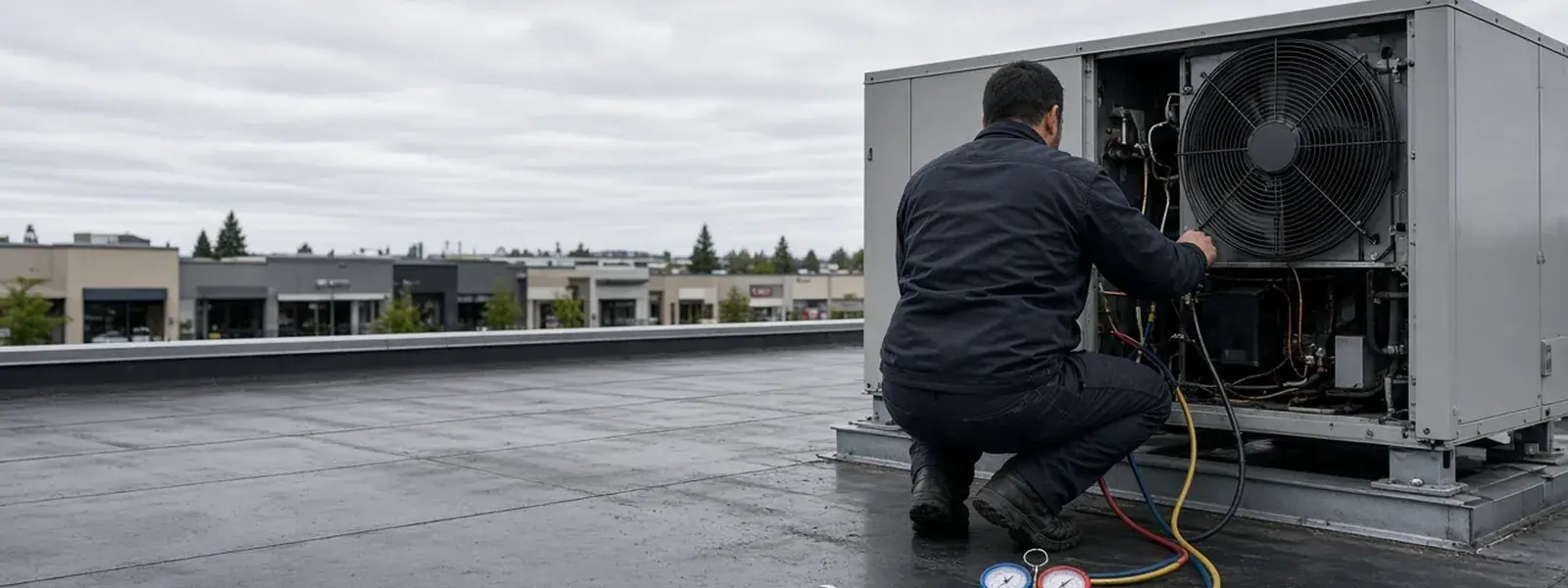
A rooftop unit that won't start, won't stage, or dumps heat into a plaza suite is a curb problem, a fan problem, or a circuit problem, not a mystery. Langley Quality Commercial HVAC repairs packaged RTUs on retail and warehouse roofs, starting with the disconnect, the data plate, and the fault the board actually stored. We check condenser fans, scroll compressors, gas heat, and the economizer before we talk about a crane. Most Willowbrook-area plaza roofs are a row of 5 to 25 ton cabinets. One dead unit shouldn't take the whole strip down, and it usually doesn't if we isolate that curb.
Plaza roofs collect alder fluff, cigarette butts, and Christmas-light clips that jam condenser fans and pin economizer blades. Warehouse roofs collect different debris and longer duct that raises external static pressure. We treat those roofs as different jobs even when the cabinet is the same York or Carrier box.
If the compressor is gone and the cabinet is sound, we quote a compressor and the matching driers, not a whole changeout by default. If the curb is leaking and the heat exchanger is stained, we say that too.
What is on the ticket
- Disconnect, fuse, and incoming voltage check at the unit
- Condenser fan motor, blade, capacitor, and amp draw
- Scroll or reciprocating compressor windings, contactor, and crankcase heat
- TXV or orifice, filter drier, and sight glass if fitted
- Superheat, subcooling, and head pressure against outdoor air
- Gas heat exchanger visual, inducer, and flame signal
- Economizer actuator, outdoor air damper, and power exhaust
- Blower belt, pulley alignment, and external static pressure
- Curb gasket, flashing, and cabinet floor rust
- Condensate drain, trap prime, and overflow switch
When this call shows up
One shop in the plaza is down
Neighbour suites still run because they sit on their own curb. That's a single RTU call, and we isolate that disconnect so we're not killing the row.
The condenser fan is silent or screaming
A seized motor or a bent blade spikes head pressure and trips the high-pressure switch. The compressor then looks guilty when the fan was the fault.
The unit runs and the suite still swings
A stuck economizer, a slipping belt, or a circuit that lost a scroll will move air without delivering capacity. Gauges and damper travel tell us which one.
You see rust streaks or a wet ceiling tile under the unit
Curb gaskets dry out and cabinet floors rust through. That's a roof and a tenant problem at the same time. We find the path before we patch blindly.
Gas heat lights, then shuts off
Flame sensor, inducer pressure switch, or a dirty burner tray will drop the call after a few seconds. That's rooftop furnace work inside the same packaged cabinet.
How we work the roof
Make the roof safe and kill only that unit
We confirm hatch or ladder access, lock the local disconnect, and read the data plate for voltage, refrigerant, and tonnage. Neighbouring curbs stay live.
Pull the stored fault and watch a call
LED flash codes and controller history show high head, flame fail, or condensate trip. Then we force a heat or cool call and watch what the board actually does.
Test the outdoor fan and the compressor circuit
Amp draw, capacitor, winding ohms, and discharge temperature separate a dead fan from a shorted scroll. Superheat and subcooling confirm whether the circuit still has a working charge.
Stroke the economizer and measure ESP
A damper pinned with debris or a failed actuator will wreck both heat and cool. External static pressure tells us if the indoor blower can still hit the CFM on the data plate.
Decide repair, circuit replace, or curb conversation
A fan motor or igniter is a roof repair. A second compressor on a rusted 1998 cabinet is a different talk. You get that distinction in writing with the model and serial.
Why this shop for rooftop unit repair
Plaza roofs are a row of curbs, not one plant
We isolate the failed RTU so the rest of the strip keeps running. That's how Willowbrook-style retail is built, and we work it that way.
We measure head pressure before we blame the scroll
A dead condenser fan and a dirty coil look like a compressor failure from the suite. Gauges keep you from buying the expensive part first.
Curb leaks get named, not ignored
A wet tile under an RTU is often the gasket or the drain, not 'the roof.' We say which one it is.
Gas heat lives in the same box
Inducer, flame sensor, and heat exchanger checks are part of rooftop repair here, not a separate furnace company.
We will tell you when the cabinet is the limit
If the floor is rusted out or the curb has shifted, a new fan motor is a short chapter. You hear that on the first honest visit.
The Langley detail
Willowbrook plaza roofs are a good picture of Langley rooftop repair. You get a line of 5 to 12.5 ton packaged units on sheet-metal curbs, each serving one or two suites, with shared hatch access and very little room between cabinets. Condenser fans ingest bags and leaves. Economizer hoods face whatever wind the lot dishes out. A single seized fan motor will spike head pressure on that circuit, trip high pressure, and make the tenant think the whole HVAC plant died. It did not. Their curb died. We pull that disconnect, spin the fans by hand, and read the board before anyone talks about a crane.
Warehouse and shop roofs west and east of the plaza belt run larger cabinets, often 15 to 25 tons with dual scrolls. Those units hide a different failure pattern. One circuit dies and the space 'sort of' cools, so the call comes in late. The remaining scroll runs long, oil return gets ugly, and the second circuit follows. When we land on that roof we want both circuits on the gauges, not just the quiet one. Superheat, subcooling, and the oil sight tell us if we're looking at a leak, a failed TXV, or a compressor that has already taken metal.
Economizers are the part nobody wants to talk about and the part that ruins winters. A damper that sticks open in drizzle brings raw outdoor air across a cold heat exchanger and can freeze a coil that was never in cooling. A damper that sticks shut in shoulder season wastes compressor hours. We stroke the actuator, check the enthalpy or dry-bulb sensor, and look at the power exhaust. If the blades are packed with grit, we free them and set the minimum outdoor air back to what the suite actually needs, not to whatever the last night tech left it on.
Curb work is rooftop repair even when the fans still spin. Gaskets shrink. Screw rails rust. A cabinet that has been walked on for twenty years will walk itself off a level curb and dump rain into the supply. We check flashing, look at the ceiling below, and tell you if this is a drain, a pan, or a curb that needs a reset when the unit eventually comes off. Ignoring that and only changing a capacitor is how you get a 'fixed' unit and a stained suite.
Langley Quality Commercial HVAC treats rooftop unit repair as curb-by-curb work on plaza and warehouse roofs. If an RTU is down, send the suite number, how we get on the roof, and the make if you can read the data plate. We will tell you whether this is a fan, a refrigerant circuit, a gas fault, or a cabinet that shouldn't get another compressor. That's the difference between a repair that opens the shop and a part that only buys another week.
Towns we cover
Work is dispatched from Langley across the Fraser Valley. See every municipality on the where we work page.