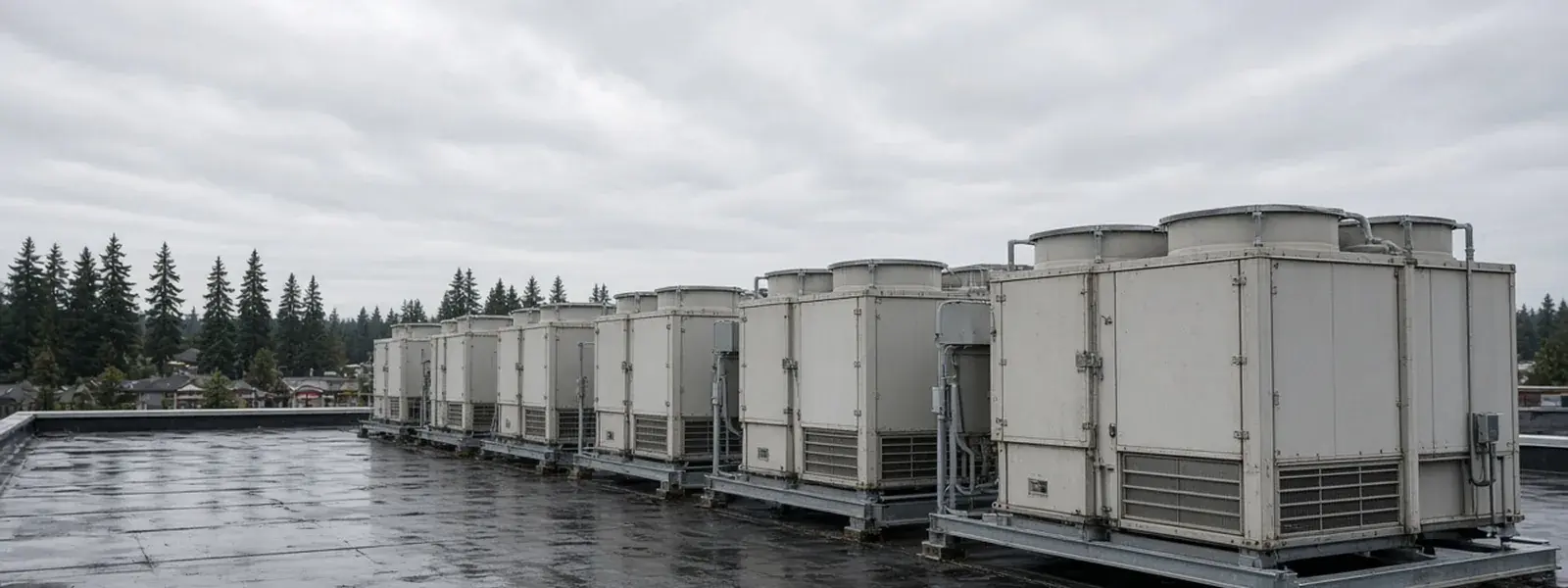
Most Langley commercial buildings don't have a mechanical room. They have a packaged rooftop unit on a curb, gas heat and DX cooling in one cabinet, duct dropping through the roof. Langley Quality Commercial HVAC specs, services, and replaces those packaged RTUs as a product family, not as a generic 'HVAC box.' Carrier, Lennox, Trane, and York cabinets dominate the plaza and shop roofs we see, with 5 to 25 tons as the usual range. If you are buying, replacing, or trying to keep a bank of them alive, the curb, the economizer, and the data plate matter more than the colour of the paint.
A packaged unit is only as good as the opening it sits on and the static it has to fight. We talk curb families, power exhaust, heat type, and controls before you fall in love with a brochure tonnage.
If you already own a row of mixed brands, we will service the mix. If you are standardizing a plaza, we will help you pick one family so the next ten years of parts are not a scavenger hunt.
What is on the ticket
- Packaged unit selection: gas-electric, electric-electric, or heat pump
- Tonnage and IEER or SEER2 matched to load, not to a brochure
- Curb family, adapter, and gasket spec for the cabinet that will sit
- Economizer type: dry-bulb, enthalpy, or comparative, plus power exhaust
- Heat section: staged gas, modulating gas, or electric heat kit
- Electrical match: 208/3, 460/3, or single-phase, MCA, and MOP
- Controls: conventional stat, communicating controller, or BAS interface
- Blower and pulley package aimed at the design external static pressure
- Service on mixed Carrier, Lennox, Trane, and York rows
- Startup sheet: charge, superheat, subcooling, manifold pressure, ESP, OA minimum
When this call shows up
You are standardizing a plaza on one packaged family
Mixed leftovers from every tenant improvement make parts and curb adapters a mess. Picking one curb family and one control language pays off on the next five changeouts.
The brochure tons don't match the duct you have
A high-SEER2 coil on a high-static duct won't deliver the CFM on the page. We pick the blower package from ESP, not from the cover photo.
You need gas heat and cooling in one cabinet
That's the default packaged RTU in Langley. We spec the heat section and the DX circuits together so you are not buying a cooling-only box and a rooftop furnace.
An old curb family is orphaned and parts are thinning
1990s footprints and discontinued boards turn every service call into a hunt. A current packaged line with a real adapter ends that.
Power exhaust or more outdoor air was never in the original unit
A denser occupancy or a kitchen next door changes the air balance. The packaged option list has to include economizer and exhaust, not a hope that the door does it.
How we work the roof
Read the existing data plates and the curb family
Brand, tons, voltage, gas, and the actual opening tell us whether we're staying in a Carrier, Lennox, Trane, or York lane, or crossing families with an adapter.
Match tons and outdoor air to the suite, not the brochure
Load and ASHRAE-style outdoor air decide capacity. Then we pick IEER or SEER2 equipment that can hit that capacity at the ESP the duct will present.
Spec heat, economizer, and exhaust as options, not afterthoughts
Staged or modulating gas, dry-bulb or enthalpy economizer, and power exhaust get written into the order. Leaving them off is how you land a cabinet that can't breathe.
Confirm electrical and gas against the new plate
MCA, MOP, and manifold pressure on a current packaged unit are not the 2001 numbers. Disconnect and pipe get checked before the unit ships.
Set the cabinet and commission the package as a system
After the curb and connections we set charge, superheat, subcooling, gas, economizer minimum, and ESP. A packaged unit that's only 'running' isn't finished.
Why this shop for packaged rooftop units
We speak curb families, not just brand names
A York footprint isn't a Carrier footprint. The adapter and the gasket are the job as much as the compressor badge.
Mixed roofs are normal and we service them
Langley plazas are a museum of leftover cabinets. We will keep the mix alive and tell you when standardizing is the smarter next buy.
Options get ordered with the unit
Economizer, power exhaust, and the right heat kit are cheaper on the factory order than as a rooftop invention later.
ESP drives the blower package
We won't sell you a tight-coil SEER2 cabinet into a high-static duct without saying the fan table will lose.
Startup numbers belong with the packaged sale
Charge, gas, and OA minimum go on a sheet. The cabinet is a system, not a crate.
The Langley detail
Carrier, Lennox, Trane, and York packaged rooftops are the everyday language of Langley commercial roofs. You see them on plazas, shops, and light industrial, usually 5 to 25 tons, gas heat over DX, sitting on a sheet-metal curb that was ordered with a building in the 1990s or 2000s. Each factory has a curb family and a control language. A communicating Lennox board doesn't think like a conventional 24-volt Carrier. A Trane footprint doesn't drop on a York opening. When we spec a packaged unit we're picking a family you can live with for parts, adapters, and the next tech who opens the panel. Badge shopping without the curb conversation is how you buy a cabinet that needs a custom transition and a translator board.
The packaged idea is simple and easy to underspec. One cabinet holds the evaporator, the condenser, the blower, the heat exchanger, and usually an economizer. That only works if the options on the order match the building. A cooling-only box on a Langley warehouse is a winter problem. A unit without power exhaust on a tight retail suite will pressurize doors. A dry-bulb economizer in a wet valley will take outdoor air when the enthalpy is useless. We write heat type, economizer type, and exhaust on the same page as tons. Factory options are cheaper than a rooftop retrofit after the crane has left and the tenant is already complaining about the front door.
Static pressure is where packaged units quietly fail their brochure. Newer SEER2 coils are thicker. They need a blower and a duct that can still deliver design CFM. A 2002 cabinet with a loose coil and a big pulley could hide a crushed return. A 2026 cabinet on the same duct will sit off the fan table and the suite will feel short. We measure ESP on the existing system before we pick the replacement packaged unit, and we pick the pulley or the drive to that number. If the duct can't be saved, we say so. Selling tons into a blocked trunk isn't a packaged-unit strategy. It is a callback.
Standardizing a plaza is a property decision, not a vanity one. If every curb is a different brand and a different vintage, every capacitor, igniter, and economizer actuator is a special. Owners who pick one family for the next three changeouts get a parts shelf that makes sense and a curb adapter they can reuse in spirit. We will still service the orphans. We just won't pretend a roof with six factories on it is easy to keep cheap. When you are ready to start a lane, we will match voltage, gas, and curb so the next cabinet is a planned drop, not another one-off.
Langley Quality Commercial HVAC treats packaged rooftop units as the default commercial system in this town, not as a generic box with a badge. If you are buying, replacing, or trying to make a mixed row of Carrier, Lennox, Trane, and York cabinets behave, send the data plates and a photo of the curbs. We will tell you which family to stay in, what economizer and heat options belong on the order, and whether that opening can take the next box without a leaky adapter surprise.
Towns we cover
Work is dispatched from Langley across the Fraser Valley. See every municipality on the where we work page.