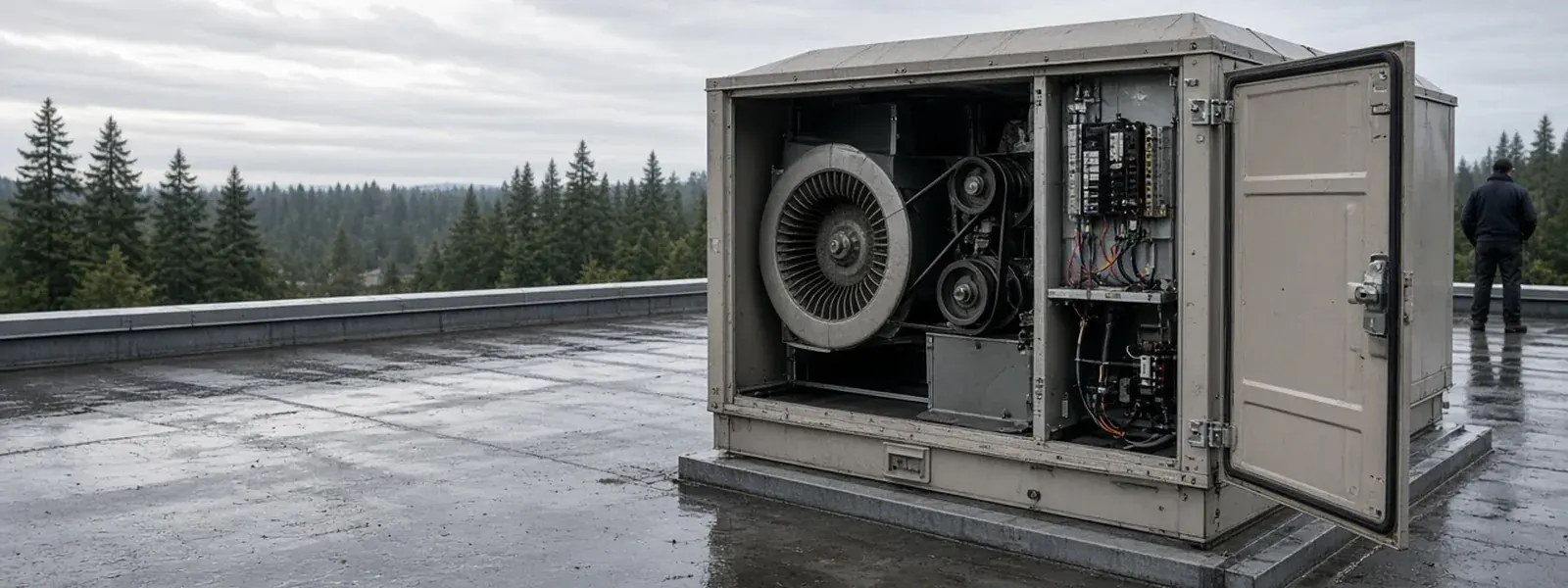
When a Langley store, warehouse, or office stops holding temperature, the problem might be a rooftop unit that won't stage, an indoor air handler that locked out, a split condenser that died, or a control that never started the call. Langley Quality Commercial HVAC starts with heat or cool and works through safeties, refrigerant, airflow, and controls before anyone orders a part. Guessing from the thermostat is how you replace a board and still have a hot suite. We tell you what failed, what we can repair on site, and what is waiting on a compressor or heat exchanger.
The City of Langley and the Township of Langley are not the same building stock. Downtown City buildings sit on tighter lots, older electrical rooms, and stacked tenants, with a mix of packaged rooftops, closet air handlers, and leftover splits. Township sites along the industrial belts run longer duct, bigger packaged cabinets, and hanging unit heaters in the bays. Access, gas shutoffs, and who holds the keys change from one address to the next. We ask those questions on the first call so the tech isn't standing at a locked door with a dead unit inside.
If the building has more than one system, we can walk the rest after the down unit is stable. Property managers use that walk to plan the next failure instead of learning about it from a tenant text at 7 a.m.
What is on the ticket
- Thermostat, occupancy sensor, and BAS point check against the actual call at the unit
- Lockout code pull from the controller, LED flash, or fault history
- Superheat and subcooling compared to the data plate refrigerant and metering device
- External static pressure at the supply and return openings
- Economizer damper stroke, enthalpy or dry-bulb sensor, and relief fan
- Gas heat inducer, igniter, flame sensor, rollout, and limit circuit
- Condenser fan amp draw, capacitor, and contactor inspection
- Compressor winding ohms, oil sight glass, and discharge temperature
- Condensate trap, pan, and overflow switch
- Curb flashing, cabinet rust, and hail-guard or debris load on the coil
When this call shows up
The space won't reach setpoint
One suite is warm or cold while the rest of the plaza feels fine. That usually points to a single RTU, a stuck zone damper, or a control that never started the compressor or gas valve.
The unit short cycles or hard-locks
High pressure, low pressure, flame failure, or limit trips leave the board in lockout. Resetting without finding the cause just burns another start on the compressor or inducer.
You hear a fan scream or smell burnt dust at start-up
A seized condenser fan, a glazed belt, or a heat exchanger that's rolling out won't fix itself. Those calls belong on the unit, not in a thermostat swap.
Water shows up under a curb or around a drain
A cracked pan, a dry trap, or a curb that has pulled away from the membrane dumps condensate into the suite. We trace the leak before we talk about a new cabinet.
Tenants say the air feels stale or the space swings all day
A stuck economizer, a failed enthalpy sensor, or a fan that can't overcome the external static pressure will heat and cool on paper while the room never settles.
How we work the job
Confirm the call at the thermostat and the unit
We verify occupancy, setpoints, and whether the BAS or stat is actually commanding W, Y, or G. A lot of 'dead units' are a failed transformer, a stolen occupancy schedule, or a sensor that thinks the room is already happy.
Read safeties and stored lockouts
Pressure switches, rollout, high limit, condensate overflow, and the board's fault history tell us if this is a flame-failure heat call, a high-head cool call, or a control that has given up. We don't reset and walk away.
Measure the refrigerant circuit if it is a DX problem
Manifold gauges, superheat, subcooling, and coil approach get compared to the data plate charge and the metering device. Low charge, a stuck TXV, or non-condensables each look different on the gauges.
Check airflow, belts, and the economizer
External static pressure, pulley alignment, belt tension, and damper stroke decide whether the blower can actually move design CFM. A jammed outdoor-air damper in a Fraser Valley drizzle will fool you into chasing refrigerant.
Write the findings against the data plate
Make, model, serial, refrigerant, and what failed go on the ticket with the unit location. You get a clear repair path and a note when the cabinet, compressor, or heat exchanger is the wrong spend.
Why this shop for commercial hvac repair
We diagnose the circuit, not the loudest part
A bad capacitor and a dying scroll can sound the same from the parking lot. Gauges, amp draw, and the board history keep you from buying the wrong piece twice.
City and Township access gets planned first
Hatch keys, mechanical-room access, gas cocks, and who owns the keys are not the same on a downtown City walk-up and a Township warehouse. We ask before the truck leaves.
Your file gets unit IDs, not a vague 'HVAC was down'
Property managers need the unit number, the data plate, and the failed component. That's what we put on the work order.
Mixed brands on one site are normal here
A Carrier next to a York next to a leftover Lennox from a tenant improvement is a typical Langley plaza. We carry the common boards, igniters, and fan motors for that mix.
We will say when another compressor is a bad bet
A rusted cabinet, a cracked heat exchanger, or a 20-year R-22 circuit changes the conversation. Repair is still the first look. We just won't pretend a dying box is a long-term plan.
The Langley detail
Commercial HVAC repair in Langley is not one roof culture. Plenty of plazas still run packaged rooftops, and we work those every week. We also see indoor air handlers, split condensers behind shops, VRF banks in newer offices, make-up air on kitchens, and unit heaters over warehouse aisles. The City of Langley has a lot of older two-storey walk-ups where the unit might sit on a short curb or in a tight mechanical closet above a single suite. The Township warehouse belts spread the same tonnage across longer duct and higher roofs. That changes how a 'no cool' call presents. In the City you often have one tenant, one unit, and a thermostat the occupant can reach. In the Township you may have a BAS point, a long return, and a unit you can't hear from the floor. We treat those as different jobs even when the cabinet badge matches.
A useful repair starts at the data plate, not the complaint. Refrigerant type, factory charge, MCA, MOP, and gas manifold pressure tell you what the unit was built to do. Then we compare live superheat and subcooling, inducer draft, and external static pressure to that plate. If ESP is already above the blower table, adding charge won't cool the suite. If the economizer is pinned open on a wet January morning, the gas heat will run its heart out and the room will still feel raw. Those are measurement problems, and they are how we keep you from swapping a gas valve that was never the fault.
Controls are where a lot of Langley service calls actually live. Occupancy sensors in retail, night setback on offices, and a BAS that lost a point after a power bump will all look like a dead unit. We confirm 24-volt call, transformer health, and whether Y or W is even present at the unit before we pull a panel and start condemning boards. When the board has a stored lockout, we want the first fault, not the last one the night tech cleared. Flame failure after a wet wind, high head after a plugged condenser, and a condensate overflow after a crushed trap each leave a different trail.
Repair still has a stop point. Scroll compressors on dual-circuit 10 to 20 ton cabinets are worth changing when the heat exchanger, cabinet, and connections are sound. They are a poor spend when the cabinet floor is rusted through, the evaporator is packed with alder fluff, and the outdoor-air damper has not stroked in years. We will repair the down circuit to get the suite open, then put the rest of the plant in writing so you can budget a changeout instead of meeting every failure as a surprise. That's the conversation property managers actually want.
Langley Quality Commercial HVAC keeps commercial HVAC repair focused on what the building is doing today and what the next season will do to the same cabinet. If you have a plaza, a shop, or a warehouse that won't hold setpoint, call with the address, how we get to the equipment, and a photo of the data plate if you can get one. We will tell you whether this is a part, a charge, a damper, or a unit that has reached the end of a sensible repair.
Towns we cover
Work is dispatched from Langley across the Fraser Valley. See every municipality on the where we work page.